

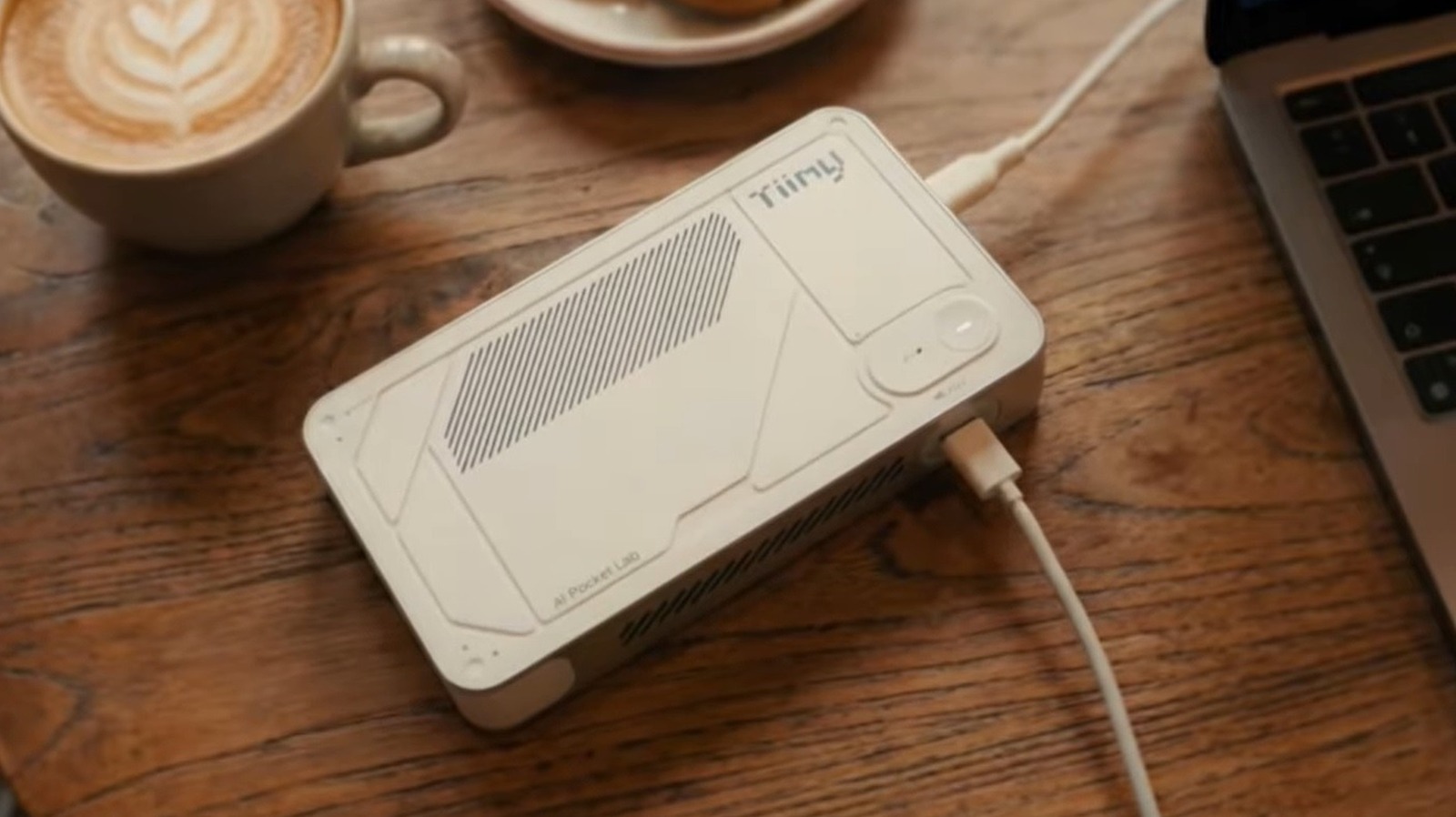
When one thinks of supercomputers, the image that typically comes to mind is a sprawling facility filled with complex hardware and extensive data cabling. However, Tiiny AI, a US-based startup, has challenged this notion by introducing a supercomputer that can comfortably fit in your pocket. This groundbreaking device, known as the AI Pocket Lab, boasts capabilities that are said to rival those of traditional, massive supercomputers.
But how can a pocket-sized device be classified as a supercomputer? While there is no universal definition, supercomputers are generally recognized for their exceptional ability to process workloads that far exceed those manageable by standard consumer hardware. The distinction here lies in performance rather than physical size. The AI Pocket Lab has been explicitly designed to execute large language models (LLMs) locally, a task typically reserved for machines equipped with multiple GPUs or those housed in data center environments. The claim that it can fit 'doctorate-level' AI into a portable format certainly places it well beyond the capacity of ordinary consumer devices.
With that context established, let's delve into what makes the AI Pocket Lab a standout device in the realm of supercomputing.
Inside the AI Pocket Lab
The innovative architecture of the AI Pocket Lab combines hardware elements that prioritize memory capabilities over sheer processing power. The device is equipped with a 12-core ARM processor paired with an impressive 80GB of LPDDR5X RAM, of which approximately 48GB is allocated for a dedicated neural processing unit (NPU) specifically designed to manage AI-related tasks.
This unique configuration empowers the AI Pocket Lab to run LLMs locally, including models with up to 120 billion parameters. The performance metrics are equally impressive, with the device achieving up to 190 trillion operations per second (TOPS) across both the processor and the NPU, resulting in output speeds of 18 to 40 tokens per second. To put this into perspective, producing four tokens corresponds to about three words, allowing for a fluid and practical user experience.
Additional features include a 1TB PCIe 4.0 SSD, Wi-Fi and Bluetooth connectivity, three USB-C ports, and an integrated microphone. It's essential to note that the AI Pocket Lab is not a standalone device; it connects directly to a Windows or macOS host system, and it is also compatible with Linux systems without requiring a dedicated client, enabling network access as well. The developers have confirmed support for over fifty open-source LLMs.
What makes this device even more remarkable is its compact size. The AI Pocket Lab measures approximately 5.6 inches by 3.15 inches, is less than an inch thick, and weighs only 10.5 ounces, making it comparable to a smartphone.
The Importance of Local AI
This brings us to a critical question: why does the AI Pocket Lab matter in today's interconnected world, where AI assistants are readily available on smartphones? One of the most significant advantages of this device is its ability to run AI models independently of cloud infrastructure. This feature is crucial from a privacy standpoint, as many users have valid concerns regarding the sharing of personal data with online AI services. Furthermore, the AI Pocket Lab’s offline capabilities allow users to access AI technology in environments with limited or no internet connectivity.
Another important distinction lies in the device's capacity to handle significantly larger AI models compared to typical offline chatbots. For instance, while a standard offline chatbot like Llama 3.1 can manage around 8 billion parameters, the AI Pocket Lab can efficiently operate models with up to 120 billion parameters.
The development of the AI Pocket Lab also reflects a broader trend towards edge computing, where data processing occurs closer to the source rather than relying on energy-intensive data centers. For context, the device comes with a 65-watt power supply and has a thermal design power (TDP) rating of 30 watts, positioning it more in line with a standard laptop rather than large-scale AI infrastructure.
Source: SlashGear News