

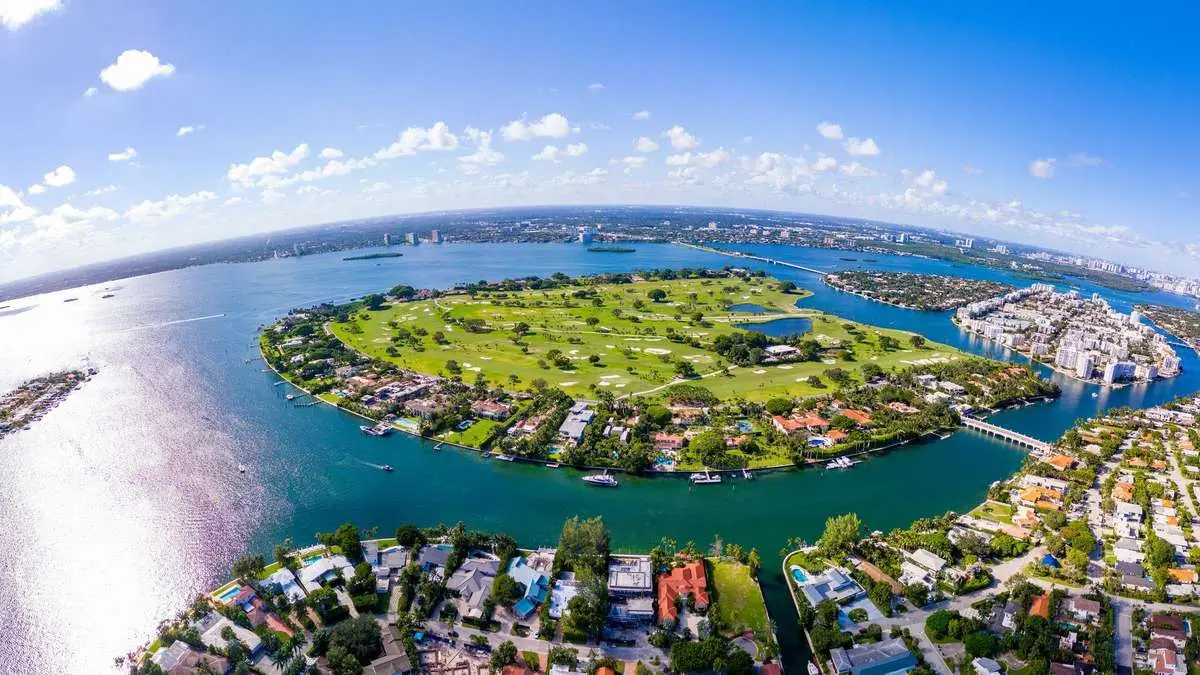
Indian Creek Island, a man-made oasis in Biscayne Bay just off Miami Beach, has earned the nickname 'Billionaire Bunker' for good reason. This tiny 300-hectare patch of land is one of the most exclusive residential areas on Earth, where some of the world's wealthiest individuals have chosen to put down roots. Among its celebrated residents are Meta CEO Mark Zuckerberg, Amazon founder Jeff Bezos, former U.S. President Donald Trump, supermodel Tom Brady, and music producer David Guetta. The island's allure goes beyond sun, sand, and celebrity: It offers a unique combination of extreme privacy, low taxes, and a community that measures net worth in the tens of billions.
The story of Indian Creek Island began in the early 20th century when the land was artificially created through dredging operations. Over the decades, it transformed from a sparsely populated retreat into a fortified haven for the ultra-wealthy. Today, the island is governed by its own municipal authority, the Village of Indian Creek, which maintains a dedicated police force that patrols both land and water around the clock. This level of security is a major draw for billionaires who value anonymity and safety above almost everything else.
Mark Zuckerberg made headlines in late 2025 when he purchased a sprawling estate on the island for a staggering $170 million. The property, which once belonged to a prominent real estate developer, is currently undergoing extensive renovations. Zuckerberg's move from California to Florida reflects a broader trend among tech billionaires seeking to escape the Golden State's high taxes and regulatory environment. Jeff Bezos, meanwhile, owns not one but three properties on Indian Creek, having spent a combined total exceeding $200 million over the past few years. Bezos has been active in the Miami real estate market since 2023, when he moved his primary residence from Washington state to Florida.
Donald Trump's connection to the island is less direct but equally notable. The 45th and current 47th President of the United States owns a private club and residence on the island's northern tip, though he primarily resides at his Mar-a-Lago estate in Palm Beach. However, Trump's presence on Indian Creek underscores the island's role as a gathering place for political and economic elites. Other residents include Ivanka Trump and her husband Jared Kushner, who purchased a home on the island in 2024 after leaving Washington.
Tax Advantages and the Exodus from California
Perhaps the most compelling reason billionaires are flocking to Indian Creek Island is Florida's favorable tax environment. The state imposes no personal income tax, no estate tax, and no capital gains tax. This stands in stark contrast to California, which has the highest income tax rate in the country at 13.3% and has proposed a 'Billionaire Tax' — a one-time 5% wealth levy on assets over $1 billion. The proposed tax has accelerated the relocation of high-net-worth individuals and their companies to Florida.
Prominent venture capitalist Peter Thiel, a co-founder of PayPal, moved his companies to Florida in early 2026, citing the state's business-friendly climate. Thiel now resides in the Miami area, though not directly on Indian Creek Island. The inflow of billionaires has significantly boosted Florida's economy, particularly in real estate, construction, and luxury services. However, it has also sparked debates about wealth inequality and the fairness of a system where the richest Americans can effectively choose their tax jurisdiction.
The tax migration is not limited to individuals. Several tech startups and hedge funds have established headquarters in Florida, lured by lower operating costs and a lighter regulatory burden. The Miami metropolitan area, once known primarily for tourism and international trade, is now emerging as a hub for technology and finance. Indian Creek Island sits at the epicenter of this transformation, symbolizing the growing concentration of wealth and influence in a single geographic space.
Security and Privacy: The Fortress Mentality
Indian Creek Island's security measures are extraordinary. The village operates its own police department, with officers stationed at a single checkpoint that controls all vehicle access via a bridge from the mainland. The police force also uses patrol boats to monitor the waterways, ensuring that unwanted visitors cannot approach by sea. Additionally, each residence is equipped with state-of-the-art surveillance systems, and many homeowners employ private security teams.
This level of protection is necessary given the high-profile nature of the residents. Billionaires are frequent targets for kidnappers, extortionists, and paparazzi. The island's isolation provides a buffer against these threats, allowing residents to live relatively normal lives in an otherwise abnormal environment. However, critics argue that these measures create a 'gated community of the super-rich' that exacerbates social divisions and reinforces the notion that wealth buys immunity from common societal problems.
The island's exclusivity extends to its amenities. Indian Creek features a private golf course, tennis courts, a marina, and a beach club — all accessible only to residents and their guests. The village also operates its own wastewater treatment plant and electrical substation, ensuring self-sufficiency even during hurricanes. These features come at a steep price: property taxes on the island can exceed $500,000 per year, but for billionaires, such costs are negligible compared to the benefits of privacy and security.
The Wealth Gap: A Microcosm of Global Inequality
The concentration of wealth on Indian Creek Island has not gone unnoticed. In a recent episode of his podcast 'Lanz + Precht,' German television host Markus Lanz remarked that the combined net worth of island residents surpasses the gross domestic product of Austria, a nation of nearly 9 million people. Lanz expressed dismay at the inequality, saying, 'It makes you sick. Not because you don't begrudge people their wealth, but because you realize how much money and influence are concentrated in the hands of very few.' He further questioned why the political spectacle in the United States fails to address the fundamental issue: 'Why the hell aren't you paying appropriate taxes?'
The data supports Lanz's concern. According to a 2025 Oxfam report, the world's richest 1% own 48% of global wealth, while the bottom 50% hold less than 2%. Indian Creek Island represents a stark microcosm of this disparity. The residents, including Zuckerberg, Bezos, and Trump, collectively control assets worth hundreds of billions of dollars — a sum that dwarfs the economies of many nations. The island's existence raises uncomfortable questions about tax policy, social mobility, and the role of government in redistributing wealth.
Proponents of the billionaire enclave argue that these individuals create jobs, drive innovation, and pay significant taxes in other forms, such as sales and property taxes. They also point out that Florida's low tax environment attracts businesses and wealthy individuals who would otherwise move their operations offshore, thereby keeping capital within the United States. Critics, however, counter that the ability to avoid federal income tax by relocating to no-tax states undermines progressive taxation and exacerbates income inequality.
A Historical Perspective: Gilded Age Enclaves
Indian Creek Island is not the first billionaire haven in American history. During the Gilded Age of the late 19th century, wealthy industrialists such as Andrew Carnegie, John D. Rockefeller, and Cornelius Vanderbilt built extravagant summer cottages in places like Newport, Rhode Island, and the Adirondacks. These enclaves served as retreats from urban chaos and allowed the rich to socialize among themselves. Similarly, in the 1920s, the development of Palm Beach attracted figures like Joseph P. Kennedy and the Vanderbilts, who built opulent mansions along the ocean.
What distinguishes Indian Creek Island is its modern security apparatus and its complete isolation from public access. Unlike Newport, where many mansions are open to tourists, Indian Creek's residences are hidden behind walls, gates, and water barriers. This reflects a broader trend among the ultra-wealthy: an increasing desire for privacy driven by the rise of social media, ubiquitous surveillance, and heightened awareness of security risks.
The island also benefits from advances in technology that allow billionaires to run their empires remotely. With high-speed internet, private jets, and satellite communications, residents can oversee global operations from the comfort of their island homes. This flexibility has made Indian Creek an attractive base for tech entrepreneurs who are not tied to physical offices.
Real Estate Market and Future Trends
The demand for property on Indian Creek Island shows no signs of slowing. Real estate agents report that listings rarely come on the market, and when they do, they sell quickly for well above asking price. The average home value on the island exceeds $20 million, with the priciest estates commanding upwards of $100 million. The recent purchases by Zuckerberg and Bezos have further driven up prices, creating a feedback loop of exclusivity and value.
Future developments may include additional luxury amenities, such as a private yacht club or a helipad, to cater to residents who travel by helicopter. There is also talk of expanding the island's footprint through further dredging, although environmental concerns have delayed such plans. For now, Indian Creek Island remains a fixed-size oasis that can accommodate only a limited number of families — ensuring its status as the ultimate status symbol for the world's richest individuals.
The broader implications of the billionaire exodus to Florida are significant. If the trend continues, it could reshape the geographic distribution of wealth in the United States, leading to increased political influence for the South and a hollowing out of the tax bases in states like California and New York. This dynamic has already sparked discussions in Congress about a federal wealth tax or a minimum tax for billionaires, though such measures face strong opposition from powerful lobbying groups.
Indian Creek Island stands as a testament to the extremes of modern capitalism. It is a place where the wealthiest 0.001% can live in a bubble of luxury, protected from the outside world by walls of water and private police. Whether this concentration of wealth is sustainable or morally justifiable remains a matter of fierce debate. What is clear is that the 'Billionaire Bunker' will continue to fascinate and provoke as long as it exists.
Source: Merkur News